Parkinson's Rehabilitation in Bangalore
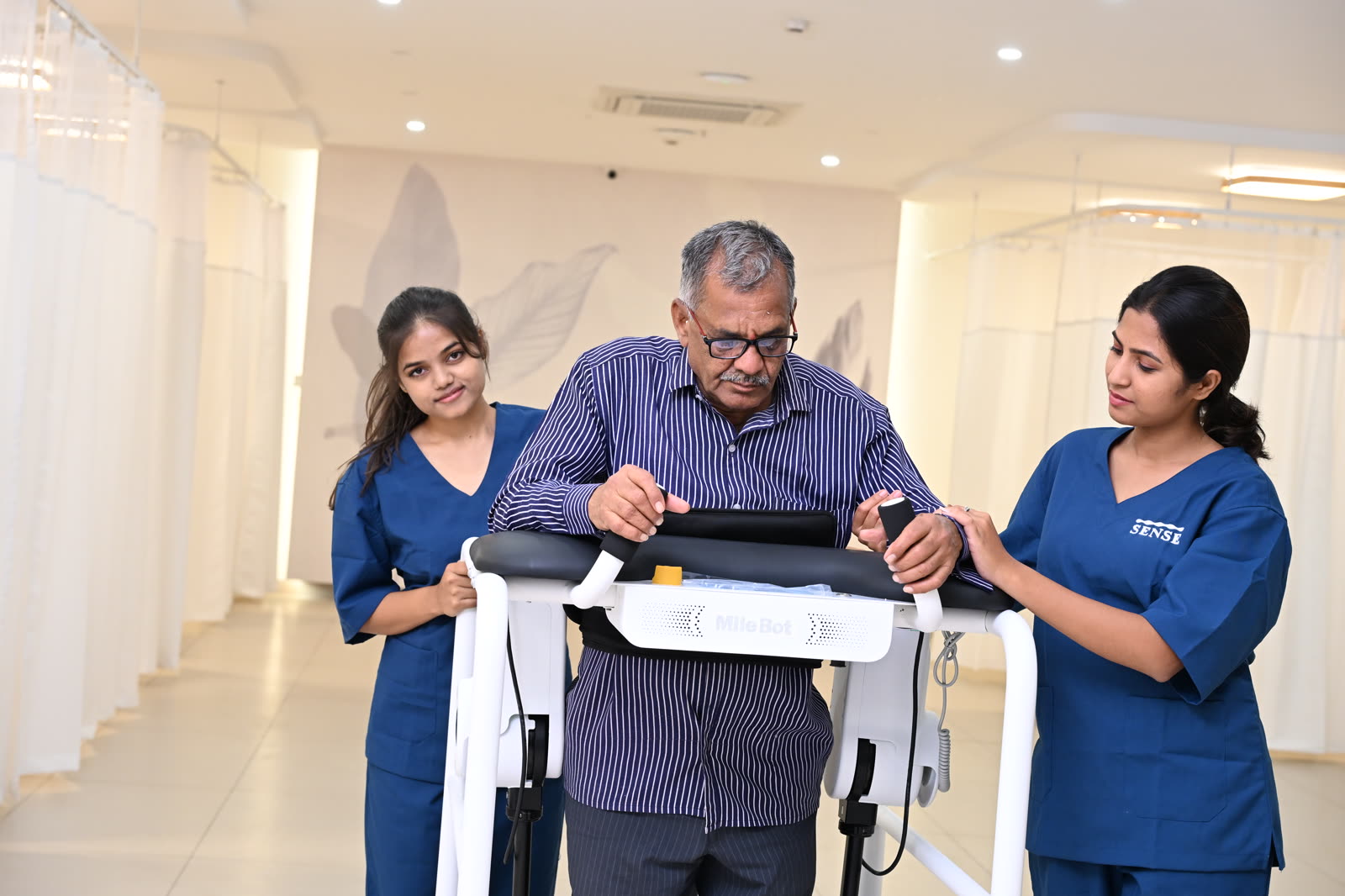
SENSE Health provides inpatient, OPD and home rehabilitation for Parkinson's disease: physiotherapy for walking and balance, cueing strategies for freezing of gait, LSVT BIG movement training, speech and swallow therapy in Kannada and English, and fall-prevention training, led by a consultant physiatrist with a neurologist for medical review.
Rehabilitation cannot stop or reverse Parkinson's. What it can do, with good evidence, is make walking, balance, speech, swallowing and daily tasks safer and easier.
What the Evidence Says
A Cochrane review of 39 trials (1,827 people) found that physiotherapy improved walking speed, walking distance, balance, functional mobility and movement scores in the short term compared with no therapy. The gains are real but often modest, and the same review found no clear difference in fear of falling or quality of life.
A 2024 Cochrane network meta-analysis of 154 trials (7,837 participants) found benefit from most types of exercise, with little evidence that any one type is clearly better. Doing it consistently matters more than the exact type. Falls are common: a review of 22 studies found about 60% of people with Parkinson's fell at least once during follow-up and about 39% fell repeatedly, which is why fall prevention is built into the programme.
Freezing of gait responds to cueing: the European physiotherapy guideline recommends practising cues for at least three weeks, three times a week, and notes that if a cue helps, it is usually visible within one session. rTMS for Parkinson's motor symptoms carries Level B evidence in the 2020 international guideline, so at SENSE Health it is considered case by case rather than offered routinely.
Read the full guide: Parkinson's Rehabilitation in Bangalore: Gait, Balance & Speech
What Parkinson's Rehabilitation Involves
Strength, gait and balance exercise, with therapy timed around the person's ON periods when medication is working best.
Visual, auditory and attention cues practised with the physiotherapist until the person can use them at home.
Large-amplitude movement training to counter the small, slow movements of Parkinson's.
For soft voice and swallowing problems, in Kannada or English, charged per session.
Fall-risk assessment, balance training and home-safety advice for the family.
Daily tasks, dressing and eating, and an exercise plan to continue at home with OPD follow-up.
Who We Admit
Medication is prescribed and adjusted by the treating neurologist; our neurologist reviews neurological conditions during the stay and coordinates with your own doctor. Inpatient (direct from hospital or ICU where needed), OPD and home rehabilitation across Bengaluru.
What an Inpatient Stay Includes
Before admission, we go through a written package sheet with you that lists what is included, what is charged separately and the payment terms. You sign it only once it has been explained. Inpatient packages are available in twin-sharing or single rooms; our team recommends one based on how much help the person needs, fall risk and their goals.
Included in both packages
- Bed, attender stay and patient meals (diet plan included)
- Duty doctor consultation, 24/7 nursing and 24/7 caregivers
- Respiratory therapy (RT care), PEG-tube and catheter care
- Daily physiotherapy (one session a day in Essential, two in Advanced)
- Gait training: manual, parallel bars, tilt table and body-weight-support (unweighing) system
- Electrotherapy: TENS, NMES, IFT and therapeutic ultrasound
- Strength training, manual therapy and chest physiotherapy
- Robotic glove and advanced hand therapy; red and infrared light therapy
Advanced package adds
- A second physiotherapy session every day
- Robotic gait training (RAGT)
- High-intensity electromagnetic therapy (HIEMT) and pelvic-floor magnetic therapy
- Cryotherapy
- Balance assessment and training
- Occupational therapy
Charged separately, when clinically needed
- Speech and swallow therapy (per session)
- Hyperbaric oxygen therapy (HBOT) and rTMS (per session)
- ICU/HDU care, ICU doctors, ventilator and oxygen support, cardiac monitor, infusion and DVT pumps
- Medicines, consumables, laboratory tests and imaging
- Specialist consultations and attender meals
Every separately charged item is listed on the sheet you sign before admission, so it is never a surprise at discharge. An advance payment and a refundable security deposit apply at admission. Our admissions team verifies insurance coverage and helps with pre-authorisation. For how to compare any centre's quote, read our guide to rehabilitation costs.
Who Looks After You
Rehabilitation at SENSE Health is medically led. Inpatients are looked after by our 24/7 emergency response team: on-site doctors trained in emergency management, with ICU experience, backed by Cloudphysician's intensivists through 24/7 remote tele-ICU and Smart ICU monitoring. Meet the team on our About page.
Dr. Vaibhav Shivram Lokhande
- Co-founder, SENSE Health
- MBBS, DNB (Physical Medicine & Rehabilitation); Fellowship (Taiwan, Korea)
- Consultant Physiatrist: specialist in neuro rehabilitation, including stroke rehabilitation; 17 years of experience
- KMC Reg. No. DLH 2019 0000421 KTK · Full profile →
Dr. Manikanta
- Founder & Managing Director
- MBBS (RGUHS); Fellowship in Emergency Medicine; PG Diploma, Biomedical Engineering (IIT Delhi, in progress)
- Co-reviews our patient-education articles · Full profile →
Neurologist, 24/7 doctors and therapy team
- Neurologist for medical review of neurological conditions
- 24/7 medical officers and emergency response team
- Dedicated respiratory therapist, 24/7, for tracheostomy and ventilator patients
- Physiotherapists, occupational therapists, speech and swallow therapists (who work in Kannada), nurses, caregivers and clinical nutrition
How Admission Works
Frequently Asked Questions
Can rehabilitation slow down Parkinson's disease?
No. Physiotherapy and exercise cannot stop or reverse the disease. What they can do, with good evidence, is improve walking speed, balance and movement scores and make daily tasks safer. Regular exercise of almost any kind helps, and keeping it up matters more than the exact type.
What is freezing of gait and can it be treated?
Freezing is the sudden feeling that the feet are glued to the floor, usually when starting to walk, turning or passing through a doorway. Cueing strategies, such as stepping to a beat or over a line, are practised with the physiotherapist. The European guideline suggests at least three weeks of practice, three times a week; if a cue helps a person, it is usually obvious within one session.
Do you offer LSVT BIG at SENSE Health?
Yes. LSVT BIG, a programme of large-amplitude movements, is part of our Parkinson's rehabilitation, alongside physiotherapy, occupational therapy, and speech and swallow therapy.
Is robotic gait training or rTMS useful in Parkinson's?
Robotic gait training can give high-repetition walking practice with less fatigue, but the evidence in Parkinson's is of low certainty. rTMS for motor symptoms has Level B evidence in the 2020 international guideline. Both are considered individually at assessment, not offered as routine.
Can a person with Parkinson's be admitted after a fall or a hospital stay?
Yes. Many admissions follow a fall, a fracture or an infection that has set walking back. Patients can come directly from the hospital, with 24/7 doctors on site and a written package sheet agreed before admission.
Parkinson's Getting Harder to Manage at Home?
Book a free assessment. We will look at walking, balance, speech and swallowing, and explain what rehabilitation can and cannot change.
WhatsApp Us Call +91 96633 34659 OPD Monday–Saturday, 9 AM–7 PM · AVR Heights, 100 Feet Road, HRBR Layout 1st Block, Kalyan Nagar, Bengaluru 560043 · Get directions