Guillain-Barré Syndrome (GBS) Rehabilitation in Bangalore
After GBS is treated in hospital with immunoglobulin or plasma exchange, rehabilitation is what carries a person from the ICU bed back to walking. SENSE Health admits GBS patients directly from the ICU or ward, including those still on oxygen or a ventilator, with 24/7 doctors, Cloudphysician's intensivists through tele-ICU, a dedicated respiratory therapist 24/7, and daily physiotherapy and occupational therapy paced to fatigue.
Most people with GBS recover a great deal, but it takes months. The job of rehabilitation is to keep the person safe through the early weeks and rebuild strength step by step.
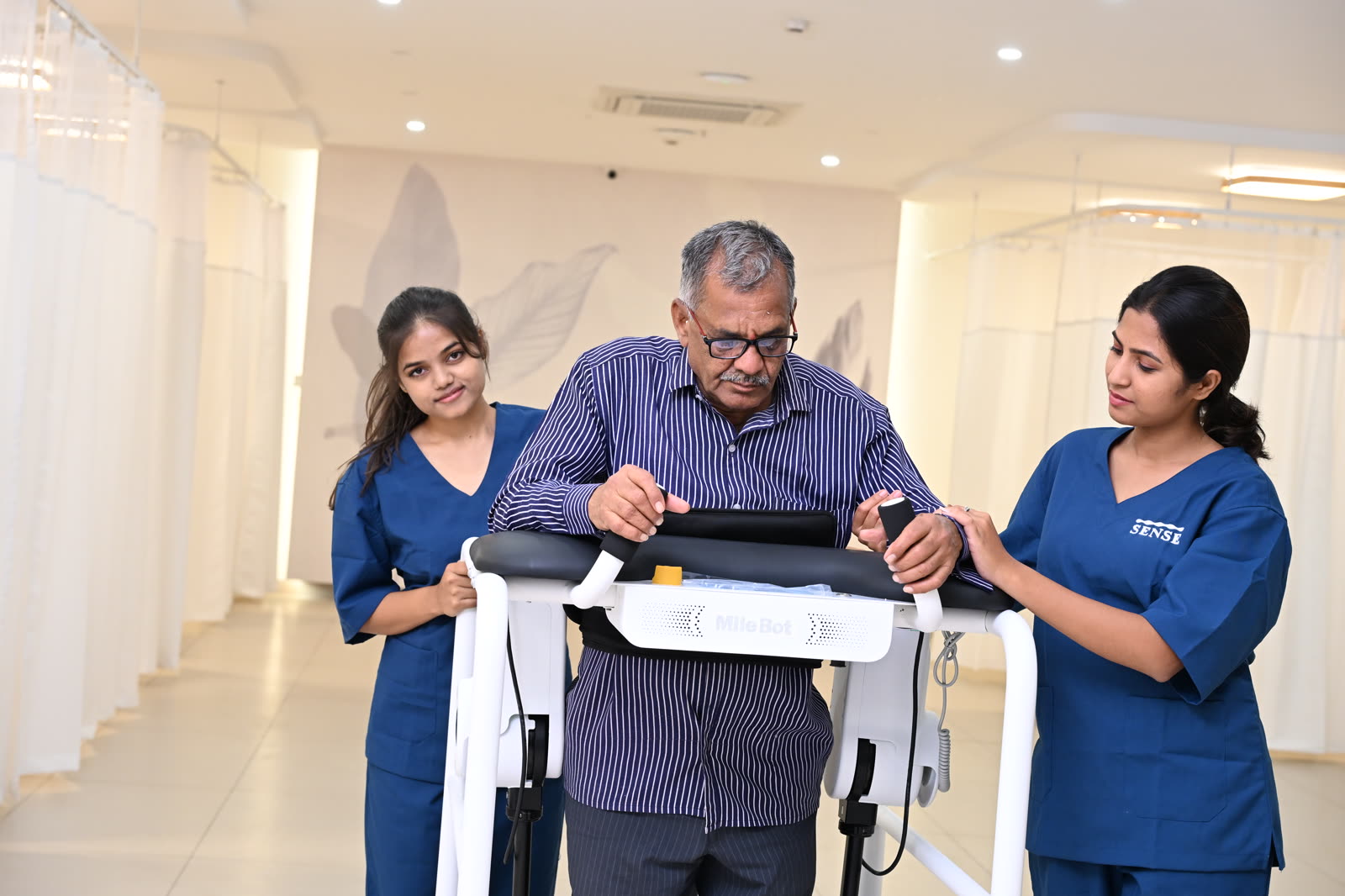
How Serious Is GBS, and What Is the Outlook?
According to the 2019 international guideline, about 20% of people with GBS develop respiratory failure and need a ventilator, and death occurs in 3–10% of cases even with the best care, usually from heart or breathing complications that can happen during recovery as well as the acute phase. That is why close medical monitoring continues after the acute hospital.
The outlook is generally good: around 60–80% of people walk independently six months after the illness starts, and improvement often continues through the first year and beyond. Even people who were completely paralysed or ventilated for long periods often show extensive recovery.
The guideline describes rehabilitation, with a rehabilitation specialist, physiotherapist and occupational therapist, as a crucial step towards recovery. A randomised trial of 79 people suggested that higher-intensity rehabilitation may help even in the later stages, so the programme is paced to fatigue rather than cut short.
Read the full guide: Guillain-Barré Syndrome (GBS) Recovery: A Rehabilitation Timeline
What GBS Rehabilitation Involves
Chest physiotherapy and respiratory therapy; for tracheostomy or ventilator patients, a dedicated respiratory therapist 24/7.
Regular positioning, range-of-motion exercise and splints while muscles are weak.
Safe-swallow assessment by speech and swallow therapists before oral feeding is advanced, charged per session.
From assisted movements to sitting, standing and walking with a frame or sticks; ankle-foot orthoses if foot drop persists.
Occupational therapy for grip, dressing and eating as the hands recover.
Therapy that respects fatigue and nerve pain, with the family shown how to pace activity at home.
Who We Admit
Acute GBS is treated by neurologists and critical-care teams in hospital, not in a rehabilitation centre; we take over once the treating team agrees the person is stable. Inpatient (direct from hospital or ICU where needed), OPD and home rehabilitation across Bengaluru.
What an Inpatient Stay Includes
Before admission, we go through a written package sheet with you that lists what is included, what is charged separately and the payment terms. You sign it only once it has been explained. Inpatient packages are available in twin-sharing or single rooms; our team recommends one based on the breathing and medical support needed, how much help the person needs and their goals.
Included in both packages
- Bed, attender stay and patient meals (diet plan included)
- Duty doctor consultation, 24/7 nursing and 24/7 caregivers
- Respiratory therapy (RT care), PEG-tube and catheter care
- Daily physiotherapy (one session a day in Essential, two in Advanced)
- Gait training: manual, parallel bars, tilt table and body-weight-support (unweighing) system
- Electrotherapy: TENS, NMES, IFT and therapeutic ultrasound
- Strength training, manual therapy and chest physiotherapy
- Robotic glove and advanced hand therapy; red and infrared light therapy
Advanced package adds
- A second physiotherapy session every day
- Robotic gait training (RAGT)
- High-intensity electromagnetic therapy (HIEMT) and pelvic-floor magnetic therapy
- Cryotherapy
- Balance assessment and training
- Occupational therapy
Charged separately, when clinically needed
- Speech and swallow therapy (per session)
- Hyperbaric oxygen therapy (HBOT) and rTMS (per session)
- ICU/HDU care, ICU doctors, ventilator and oxygen support, cardiac monitor, infusion and DVT pumps
- Medicines, consumables, laboratory tests and imaging
- Specialist consultations and attender meals
Every separately charged item is listed on the sheet you sign before admission, so it is never a surprise at discharge. An advance payment and a refundable security deposit apply at admission. Our admissions team verifies insurance coverage and helps with pre-authorisation. For how to compare any centre's quote, read our guide to rehabilitation costs.
Who Looks After You
Rehabilitation at SENSE Health is medically led. Inpatients are looked after by our 24/7 emergency response team: on-site doctors trained in emergency management, with ICU experience, backed by Cloudphysician's intensivists through 24/7 remote tele-ICU and Smart ICU monitoring. Meet the team on our About page.
Dr. Vaibhav Shivram Lokhande
- Co-founder, SENSE Health
- MBBS, DNB (Physical Medicine & Rehabilitation); Fellowship (Taiwan, Korea)
- Consultant Physiatrist: specialist in neuro rehabilitation, including stroke rehabilitation; 17 years of experience
- KMC Reg. No. DLH 2019 0000421 KTK · Full profile →
Dr. Manikanta
- Founder & Managing Director
- MBBS (RGUHS); Fellowship in Emergency Medicine; PG Diploma, Biomedical Engineering (IIT Delhi, in progress)
- Co-reviews our patient-education articles · Full profile →
Neurologist, 24/7 doctors and therapy team
- Neurologist for medical review of neurological conditions
- 24/7 medical officers and emergency response team
- Dedicated respiratory therapist, 24/7, for tracheostomy and ventilator patients
- Physiotherapists, occupational therapists, speech and swallow therapists (who work in Kannada), nurses, caregivers and clinical nutrition
How Admission Works
Frequently Asked Questions
Will my family member walk again after GBS?
Most people do: around 60–80% walk independently six months after the illness starts, and improvement often continues through the first year and beyond. Recovery is slow, and rehabilitation is what carries a person from the bed back to walking.
Can a GBS patient still on a ventilator be admitted?
Yes. A dedicated respiratory therapist is available 24/7 for ventilator and tracheostomy patients, with on-site doctors and Cloudphysician's intensivists through tele-ICU. Ventilator, oxygen and ICU/HDU care are charged separately and listed on the package sheet before admission.
Why is medical monitoring still needed after the hospital?
Because heart and breathing complications can occur during the recovery phase as well as the acute phase. Our doctors are on site 24/7, and Smart ICU monitoring is available for people who are still fragile.
How hard should therapy push?
Therapy is graded and paced to fatigue and nerve pain. A randomised trial suggested that higher-intensity rehabilitation may help even in the later stages, so the programme builds up step by step rather than stopping early.
Does rehabilitation treat the GBS itself?
No. The disease is treated in hospital with intravenous immunoglobulin or plasma exchange. Rehabilitation prevents complications while the nerves recover and rebuilds strength, walking and daily function.
Planning GBS Rehabilitation After the ICU?
Call us while your family member is still in hospital. Share the discharge summary and current breathing support, and we will explain how the transfer and the first weeks work.
WhatsApp Us Call +91 96633 34659 OPD Monday–Saturday, 9 AM–7 PM · AVR Heights, 100 Feet Road, HRBR Layout 1st Block, Kalyan Nagar, Bengaluru 560043 · Get directions