Brain Injury (TBI) Rehabilitation in Bangalore
SENSE Health admits people recovering from a traumatic brain injury directly from the ICU or ward, including those who still need oxygen, a tracheostomy or ICU/HDU-level monitoring. Rehabilitation is led by our consultant physiatrist with a neurologist, and covers movement, thinking and behaviour, communication, swallowing and spasticity, with 24/7 doctors and Cloudphysician's intensivists through tele-ICU.
Most mild head injuries recover with good information and follow-up. Moderate and severe injuries benefit from planned, team-based rehabilitation, and the earlier it starts after medical stability, the better.
Does Rehabilitation After a Head Injury Work?
Yes, for the right person at the right intensity. The Cochrane review of multidisciplinary rehabilitation for acquired brain injury in adults of working age (19 studies, 3,480 people) found that people with moderate to severe injury benefit from planned, team-based rehabilitation, and that more intensive programmes bring earlier gains. The authors were honest about the limits: the best balance of intensity and cost is not yet known.
Road crashes cause most of these injuries. India recorded 4,87,707 road accidents in 2024, and among the country's largest cities Bengaluru had the second-highest number; a NIMHANS review found 60–70% of people admitted with traumatic brain injury in India had been hurt on the roads.
After a severe injury some people remain in a coma, an unresponsive wakefulness syndrome or a minimally conscious state. Guidelines advise treating any confounding medical problems and repeating structured assessments over time, because the level of awareness can change. We assess thinking and behaviour, not only walking.
Read the full guide: Head Injury (TBI) Rehabilitation After Road Accidents in Bangalore
What Brain Injury Rehabilitation Involves
24/7 doctors, Smart ICU monitoring for fragile patients, and management of seizures, blood pressure, infections and nutrition.
Physiotherapy and gait training, with robotic gait training where it fits; most trial evidence for the robot comes from stroke.
Cognitive rehabilitation and a structured, calm routine, with the family involved in goals.
Communication therapy and safe-swallow assessment, in Kannada or English, charged per session.
Stretching, positioning, splinting and medical management of muscle stiffness.
Caregiver training before discharge, and planning for work, college and driving when the time comes.
Who We Admit
Timing is agreed with the treating neurosurgeon or neurologist; we take over once the person is medically stable enough to leave the acute hospital. Inpatient (direct from hospital or ICU where needed), OPD and home rehabilitation across Bengaluru.
What an Inpatient Stay Includes
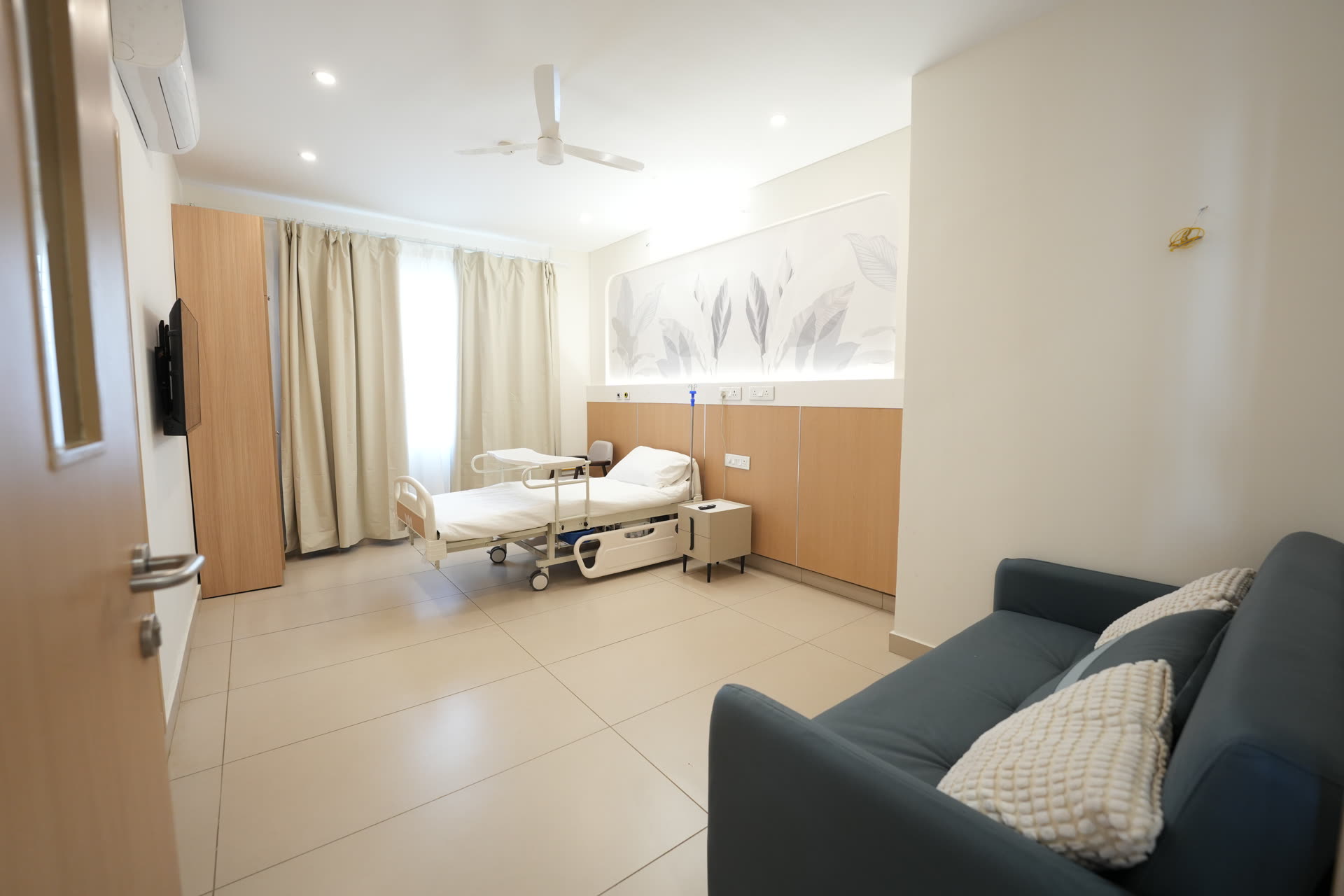
Before admission, we go through a written package sheet with you that lists what is included, what is charged separately and the payment terms. You sign it only once it has been explained. Inpatient packages are available in twin-sharing or single rooms; our team recommends one based on the medical and monitoring needs, how much help the person needs and their goals.
Included in both packages
- Bed, attender stay and patient meals (diet plan included)
- Duty doctor consultation, 24/7 nursing and 24/7 caregivers
- Respiratory therapy (RT care), PEG-tube and catheter care
- Daily physiotherapy (one session a day in Essential, two in Advanced)
- Gait training: manual, parallel bars, tilt table and body-weight-support (unweighing) system
- Electrotherapy: TENS, NMES, IFT and therapeutic ultrasound
- Strength training, manual therapy and chest physiotherapy
- Robotic glove and advanced hand therapy; red and infrared light therapy
Advanced package adds
- A second physiotherapy session every day
- Robotic gait training (RAGT)
- High-intensity electromagnetic therapy (HIEMT) and pelvic-floor magnetic therapy
- Cryotherapy
- Balance assessment and training
- Occupational therapy
Charged separately, when clinically needed
- Speech and swallow therapy (per session)
- Hyperbaric oxygen therapy (HBOT) and rTMS (per session)
- ICU/HDU care, ICU doctors, ventilator and oxygen support, cardiac monitor, infusion and DVT pumps
- Medicines, consumables, laboratory tests and imaging
- Specialist consultations and attender meals
Every separately charged item is listed on the sheet you sign before admission, so it is never a surprise at discharge. An advance payment and a refundable security deposit apply at admission. Our admissions team verifies insurance coverage and helps with pre-authorisation. For how to compare any centre's quote, read our guide to rehabilitation costs.
Who Looks After You
Rehabilitation at SENSE Health is medically led. Inpatients are looked after by our 24/7 emergency response team: on-site doctors trained in emergency management, with ICU experience, backed by Cloudphysician's intensivists through 24/7 remote tele-ICU and Smart ICU monitoring. Meet the team on our About page.
Dr. Vaibhav Shivram Lokhande
- Co-founder, SENSE Health
- MBBS, DNB (Physical Medicine & Rehabilitation); Fellowship (Taiwan, Korea)
- Consultant Physiatrist: specialist in neuro rehabilitation, including stroke rehabilitation; 17 years of experience
- KMC Reg. No. DLH 2019 0000421 KTK · Full profile →
Dr. Manikanta
- Founder & Managing Director
- MBBS (RGUHS); Fellowship in Emergency Medicine; PG Diploma, Biomedical Engineering (IIT Delhi, in progress)
- Co-reviews our patient-education articles · Full profile →
Neurologist, 24/7 doctors and therapy team
- Neurologist for medical review of neurological conditions
- 24/7 medical officers and emergency response team
- Dedicated respiratory therapist, 24/7, for tracheostomy and ventilator patients
- Physiotherapists, occupational therapists, speech and swallow therapists (who work in Kannada), nurses, caregivers and clinical nutrition
How Admission Works
Frequently Asked Questions
When should rehabilitation start after a head injury?
As soon as the person is medically stable, in agreement with the treating hospital. People with moderate to severe injury benefit from planned, team-based rehabilitation, and more intensive programmes bring earlier gains.
Can a patient in a coma or minimally conscious state be admitted?
Yes, when the acute team agrees the person is stable. Care focuses on medical stability, nursing, positioning, nutrition and repeated structured assessment of awareness, with 24/7 doctors and Smart ICU monitoring.
Do you treat memory, behaviour and thinking problems?
Yes. Cognitive rehabilitation and a structured routine are part of the programme, with the family involved in setting goals. We assess thinking and behaviour, not only walking.
What warning signs need an emergency visit after discharge?
Drowsiness lasting more than an hour when the person would normally be awake, any loss of consciousness, a seizure, vomiting, a headache that will not go away, or new confusion or weakness. Call 108 or 112.
How long does recovery take?
Recovery after a brain injury runs over months, and the pattern differs from person to person. A personalised timeline is set at admission and reviewed every week; we do not promise a fixed outcome.
Planning Care After a Head Injury?
Call us while your family member is still in hospital. Share the discharge summary and current condition, and we will explain how admission and the first weeks work.
WhatsApp Us Call +91 96633 34659 OPD Monday–Saturday, 9 AM–7 PM · AVR Heights, 100 Feet Road, HRBR Layout 1st Block, Kalyan Nagar, Bengaluru 560043 · Get directions