Chest physiotherapy is a group of techniques, including breathing cycles (ACBT), huffing, manual vibration and percussion, hand-held flutter devices and oscillating vests, that help people cough up mucus they cannot clear on their own. The best evidence, though mostly low quality, is in bronchiectasis and COPD: guidelines recommend teaching an airway clearance technique in bronchiectasis, and reviews show modest benefits such as more sputum cleared and slightly shorter hospital stays during COPD flare-ups. It is not for everyone: a Cochrane review found no benefit on death or cure in adults with ordinary pneumonia, and some conditions make chest percussion unsafe. Below is who benefits, who should not have it, and what each technique actually does.
Call 108 or 112, or go to the nearest emergency department, if your family member is struggling to breathe, is choking or gasping and cannot speak, has pale, blue or grey lips or skin, is coughing up blood, or suddenly becomes confused. Chest physiotherapy is not a treatment for these.
Why Does Phlegm Build Up in the First Place?
Healthy airways are lined with tiny hairs (cilia) that sweep mucus upwards, and a strong cough finishes the job. Phlegm accumulates when mucus is produced faster than usual (COPD, bronchiectasis, chest infection), when the cilia are damaged, or when the cough is too weak to shift it. A weak cough is the common thread in the patients we see most: people after stroke, after a long ICU stay or ventilation, with Guillain-Barré syndrome or spinal cord injury, with a tracheostomy, or frail older adults who have spent weeks in bed.
Chest physiotherapy does not dissolve mucus. It moves air behind the secretions, shakes them loose from the airway wall, and then uses a controlled huff or cough, or sometimes suction, to bring them out. Done well, it is a routine the family can learn; done on the wrong patient, it can cause harm, which is why assessment comes first.
Who Benefits From Chest Physiotherapy, and Who Does Not?
| Condition | What guidelines and systematic reviews say |
|---|---|
| Bronchiectasis | British Thoracic Society: teach every patient an airway clearance technique, offering ACBT or an oscillating PEP device first; manual techniques may be added when the person is tired or in an exacerbation (Hill et al., 2018). Cochrane (7 studies, 105 people): techniques appear safe and may improve sputum clearance, symptoms and quality of life; low-quality evidence (Lee et al., 2015) |
| COPD, stable or flare-up | Cochrane (28 studies, 907 people): during flare-ups, airway clearance reduced the need for ventilatory support (OR 0.21) and shortened hospital stay by about 0.75 days; benefits are small; no long-term effect on exacerbations (Osadnik et al., 2012) |
| Pneumonia in adults | Cochrane (6 trials, 434 people): no improvement in death or cure rate with conventional chest physiotherapy or ACBT; PEP shortened stay by 1.4 days. Conclusion: not recommended as routine treatment (Yang et al., 2013) |
| Neuromuscular weakness (GBS, spinal cord injury, motor neurone disease) | BTS: measure peak cough flow regularly; use manually assisted cough and mechanical insufflation-exsufflation when cough is too weak (Bott et al., 2009). Cochrane: cough-assist techniques may raise peak cough flow but evidence is very uncertain (Morrow et al., 2021) |
| After stroke | Respiratory muscle training (5 trials, 263 people) increased breathing-muscle strength and reduced respiratory complications (RR 0.38) (Menezes et al., 2016) |
| ICU, post-ICU and tracheostomy | Oscillating vests appear safe and help secretion clearance in selected ICU patients, but have not been shown to shorten ventilation or improve survival (Ielo et al., 2026) |
| "Post-COVID phlegm", asthma | Not covered by the reviews above; assessment first, and techniques only if secretions are genuinely retained |
The honest summary: chest physiotherapy helps people who have secretions they cannot clear. It is not a general treatment for a chest infection, and it is not a substitute for antibiotics, inhalers or oxygen when those are needed.
Which Technique Does What?
| Technique | How it works | Evidence in brief |
|---|---|---|
| Active cycle of breathing technique (ACBT) | Relaxed breathing, deep breaths, then a forced "huff" to move mucus up | 24 studies: more sputum cleared than with conventional physiotherapy, external oscillating devices or control; body of evidence rated good (Lewis et al., 2012) |
| Huff cough / forced expiration | A sharp exhalation with the mouth open, less tiring and less airway-collapsing than a hard cough | Part of ACBT; BTS bronchiectasis guideline suggests adding it to any technique (Hill et al., 2018) |
| Manual percussion, vibration and shaking | Therapist's hands clap or vibrate the chest wall during exhalation to loosen secretions | BTS: consider when independent techniques fail to clear secretions; offer as part of a regimen in fatigue or exacerbation (Bott et al., 2009) |
| Oscillating PEP devices (flutter, Acapella) | Blowing out against a valve that vibrates the airways and holds them open | Cochrane (9 studies, 213 people): similar effects to other techniques on sputum, breathlessness and quality of life; low-quality evidence (Lee et al., 2017) |
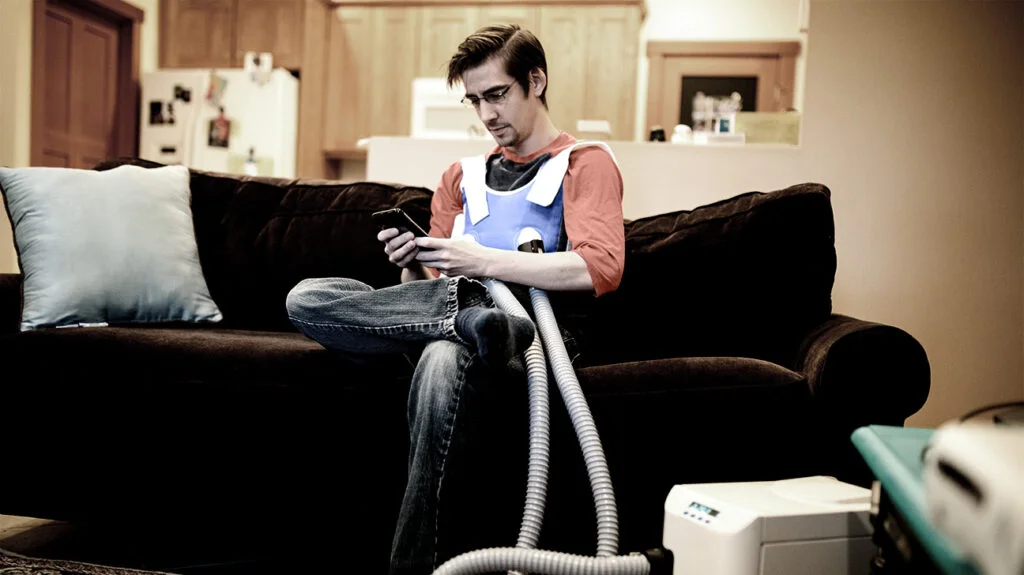
| High-frequency chest wall oscillation (vest or mechanical vibrator) | A machine delivers rapid vibrations across the chest | In COPD flare-ups (13 studies, 756 people): about 6 mL more sputum and shorter stays, but results varied widely between trials (Huang et al., 2022) |
| Postural (gravity-assisted) drainage | Positioning so the affected lung segment is uppermost | BTS: consider where not contraindicated; use modified positions without head-down tilt in people who cannot tolerate it (Hill et al., 2018) |
| Manually assisted cough and cough-assist machine | A push on the abdomen timed with the cough, or a device that blows air in then sucks it out | BTS recommendation for neuromuscular weakness; evidence very uncertain (Bott et al., 2009; Morrow et al., 2021) |
| Breathing and respiratory muscle training | Exercising the inspiratory and expiratory muscles with a resistance device | After stroke: stronger breathing muscles and fewer respiratory complications (Menezes et al., 2016) |
In practice the physiotherapist combines these: for example, ACBT with manual vibration during the huff phase for a post-stroke patient with a weak cough, or a flutter device twice daily for someone with bronchiectasis who wants to manage at home.
Who Should Not Have Chest Percussion or Vibration?
The American Association for Respiratory Care's 1991 clinical practice guideline (since retired by the AARC, but still widely used as a safety checklist) lists the situations in which postural drainage, percussion and vibration are contraindicated, nearly all of them relative, meaning the decision depends on the balance of benefit and risk for that patient (AARC, 1991). Those most relevant to families include:
- Rib fracture, with or without flail chest, and surgical wounds or healing tissue on the chest
- Active coughing of blood (haemoptysis) or a bleeding disorder, including blood-thinner-related bleeding
- Active bleeding with unstable blood pressure, or acute heart failure with fluid in the lungs
- Pulmonary embolism (a clot in the lung)
- Head or neck injury until stabilised, recent spinal surgery, or raised pressure inside the skull
- Osteoporosis or bone infection of the ribs
- Recent pacemaker placement, chest skin grafts, burns or skin infection over the chest
- Suspected untreated pulmonary tuberculosis
- Bronchospasm (tight, wheezy airways) or chest-wall pain
- For head-down positions: recent brain surgery, a brain aneurysm or any situation where pressure inside the skull must not rise, uncontrolled high blood pressure, a distended abdomen, oesophageal surgery, or a recent meal or tube feed (risk of aspiration)
Our guide to swallowing problems after stroke explains why the timing of chest physiotherapy and feeds matters so much in stroke patients.
The guideline also lists the hazards to watch for during a session, including a fall in oxygen levels, a drop in blood pressure, and vomiting; the therapist stops, returns the patient to a resting position and calls the doctor if any occur. This is why chest physiotherapy on a frail or recently ill person should start under supervision, with oxygen saturation monitored, before it is handed over to the family.
When Should Families Worry? Red Flags
Call 108 or 112 immediately if the person is struggling to breathe, choking or gasping and unable to speak, has pale, blue or grey lips or skin, is coughing up blood, or suddenly becomes confused. These are the emergency signs listed by the NHS for pneumonia.
See a doctor the same day if there is (NHS):
- Yellow or green phlegm, or a new high temperature
- Chest pain that comes and goes, or hurts when breathing or coughing
- New or worsening breathlessness, or breathing faster than usual at rest
- A cough that is lasting for weeks or not getting better
- In someone after a stroke or with a weak swallow: fever, wet cough or breathlessness after meals, which may mean aspiration pneumonia
Chest physiotherapy can continue alongside antibiotics once a doctor has assessed the person, but it should not delay the assessment.
What Does Respiratory Therapy at SENSE Health Involve?
Chest physiotherapy is included in our Essential and Advanced inpatient packages, so a post-stroke or post-ICU patient on either package does not pay per session for it. Oxygen and ventilator support are available when clinically required and are charged separately; these are listed on the written package sheet families see before admission. A typical programme looks like this:
- Assessment first: a physiotherapist checks breathing pattern, cough strength, oxygen saturation, chest sounds and the contraindication list above, and reviews the chest X-ray and medicines with our 24/7 doctors.
- Technique selection: ACBT with manual vibration for most weak-cough patients; chest vibration therapy where hands-on techniques are not tolerated; manually assisted cough for neuromuscular weakness; and advice on whether a hand-held oscillating PEP (flutter-type) device would suit home use.
- Timing around meals and feeds: sessions are scheduled before meals or well after a tube feed, with the head of the bed raised.
- Mobilisation: sitting out of bed, standing and walking are themselves airway clearance; our physiotherapists combine chest sessions with gait and strength work.
- Family training: before discharge, the attender learns the breathing cycle, safe positioning and when to stop and call.
For patients recovering from a long ICU stay or Guillain-Barré syndrome, retained secretions are often the main thing standing between the ward and home. Our guides to recovery after ICU and GBS rehabilitation explain how respiratory therapy fits into the wider programme, and inpatients are monitored through our Smart ICU partnership with Cloudphysician when continuous observation is needed.
Getting Started in Kalyan Nagar
SENSE Health is at AVR Heights, 100 Feet Road, HRBR Layout 1st Block, Kalyan Nagar, Bengaluru 560043, easy to reach from Indiranagar, Banaswadi and Hennur, and families come from Kammanahalli, Hebbal, Horamavu and Ramamurthy Nagar for respiratory therapy as part of inpatient rehabilitation, in the OPD, or at home.
At the first visit, bring the discharge summary, recent chest X-ray or CT reports, the current medicine list (including inhalers and blood thinners), and any oxygen saturation readings you have noted at home. The physiotherapist, with our doctors, assesses cough strength, chest findings and safety, and tell you whether airway clearance is likely to help or whether a doctor's review for infection, heart failure or a clot is needed first. Inpatients have 24/7 doctors and a 24/7 emergency response team. If a home programme is suitable, the attender is taught it hands-on before leaving.
OPD hours: Monday to Saturday, 9 AM to 7 PM. The initial consultation is free.
Call +91 96633 34659, WhatsApp us, email listen@sensehealth.co.in, or get directions.
Sources
- Hill AT, Sullivan AL, Chalmers JD, et al. British Thoracic Society guideline for bronchiectasis in adults. BMJ Open Respiratory Research. 2018.
- Lee AL, Burge AT, Holland AE. Airway clearance techniques for bronchiectasis. Cochrane Database of Systematic Reviews. 2015.
- Osadnik CR, McDonald CF, Jones AP, Holland AE. Airway clearance techniques for chronic obstructive pulmonary disease. Cochrane Database of Systematic Reviews. 2012.
- Yang M, Yan Y, Yin X, et al. Chest physiotherapy for pneumonia in adults. Cochrane Database of Systematic Reviews. 2013.
- Bott J, Blumenthal S, Buxton M, et al., British Thoracic Society Physiotherapy Guideline Development Group. Guidelines for the physiotherapy management of the adult, medical, spontaneously breathing patient. Thorax. 2009.
- Morrow B, Argent A, Zampoli M, Human A, Corten L, Toussaint M. Cough augmentation techniques for people with chronic neuromuscular disorders. Cochrane Database of Systematic Reviews. 2021.
- Menezes KK, Nascimento LR, Ada L, Polese JC, Avelino PR, Teixeira-Salmela LF. Respiratory muscle training increases respiratory muscle strength and reduces respiratory complications after stroke: a systematic review. Journal of Physiotherapy. 2016.
- Ielo S, Carriera L, Barone R, et al. High-frequency chest wall oscillation in critical care: a systematic review. Respiration. 2026.
- Lewis LK, Williams MT, Olds TS. The active cycle of breathing technique: a systematic review and meta-analysis. Respiratory Medicine. 2012.
- Lee AL, Burge AT, Holland AE. Positive expiratory pressure therapy versus other airway clearance techniques for bronchiectasis. Cochrane Database of Systematic Reviews. 2017.
- Huang HP, Chen KH, Tsai CL, et al. Effects of high-frequency chest wall oscillation on acute exacerbation of chronic obstructive pulmonary disease: a systematic review and meta-analysis of randomized controlled trials. International Journal of COPD. 2022.
- American Association for Respiratory Care. AARC clinical practice guideline: postural drainage therapy. Respiratory Care. 1991.
- National Health Service. Pneumonia. NHS. Accessed 2026.
This article is for general education and does not replace advice from your own doctor. If symptoms are sudden or severe, call 108 or go to the nearest emergency department.