You can lower an older person's chance of falling. Regular balance and strength exercise has the strongest evidence: a Cochrane review found exercise programmes cut the rate of falls by about 23%. Combine it with a medicine review, eye and foot checks, and a safer home. In Bengaluru, the north-east monsoon brings wet floors, slippery balconies and stairs, and the occasional power cut, so this is a good time to walk through every room with fresh eyes.
Falls are not a minor problem. The World Health Organization ranks falls as the second leading cause of unintentional injury deaths worldwide, with an estimated 684,000 deaths a year, and adults over 60 suffer the greatest number of fatal falls. In India, the Longitudinal Ageing Study in India (LASI) found that about one in eight adults aged 60 and above (12.6%) reported a fall in the previous two years. About 5.8% reported a fall-related injury (Thakkar et al., PLoS One, 2022).
Why Is the Monsoon a Risky Time in Bengaluru?
The India Meteorological Department describes October to December as the north-east monsoon season for south peninsular India. Over South Interior Karnataka, which includes Bengaluru, October usually brings the most rain of the season. That means:
- Wet bathroom and balcony tiles that stay damp for hours
- Slippery apartment staircases and building entrances, with water carried in on footwear
- Moss on outdoor steps, terraces and compound walls
- Sudden darkness when the power goes off during a storm
- Older people staying indoors and moving less for weeks at a time
Why Do Older Adults Fall?
A fall usually has several causes acting together. The World Falls Guidelines (Montero-Odasso et al., Age and Ageing, 2022) ask clinicians to check gait and balance, muscle strength, medicines, blood pressure drops on standing, vision and hearing, feet and footwear, memory and mood, conditions such as Parkinson's disease, fear of falling, bladder problems, nutrition and the home environment.
An AIIMS analysis of Indian LASI data (Biswal et al., European Geriatric Medicine, 2026) found similar links: female sex, being underweight, joint disease, previous fracture, poor vision or hearing, depression and weaker physical performance.
The guidelines suggest three simple questions. If the answer to any of them is "yes", ask for a falls assessment:
- Have you fallen in the past year?
- Do you feel unsteady when standing or walking?
- Do you worry about falling?
What Actually Prevents Falls?
Balance and strength exercise
The 2019 Cochrane review by Sherrington and colleagues included 108 randomised trials with 23,407 people living in the community. Exercise reduced the rate of falls by 23% (high-certainty evidence). Balance and functional exercises reduced it by 24%. Programmes that combined several types of exercise, usually balance plus strength training, probably reduced it by 34%. Tai Chi may also help.
The World Falls Guidelines recommend exercise that challenges balance and practises everyday movements, such as sit-to-stand and stepping. Sessions should be held three or more times a week, tailored to the person, made harder gradually, and continued for at least 12 weeks. Walking is good for general health, but the Cochrane review was uncertain whether walking programmes on their own prevent falls.
A medicine review
Some medicines raise the risk of falling, including sedatives and other medicines that act on the brain, and some heart and blood pressure medicines. The guidelines recommend a structured medicine review, with doctors reducing or stopping these where it is safe. Do not stop any medicine yourself. Take every strip and bottle to the doctor, including sleep aids and Ayurvedic products.
Dizziness when standing up
A fall in blood pressure on standing (orthostatic hypotension) is a possible hidden cause. The guidelines recommend checking blood pressure lying down and then standing. At home, encourage your parent to sit on the edge of the bed for a moment before standing, especially at night.
Eyes and feet
The guidelines support cataract surgery for those who need it. They also note that active older adults should avoid wearing multifocal glasses when walking outside, and that new glasses can briefly increase fall risk while the person adjusts. Feet and footwear matter too: the guidelines specifically flag walking barefoot and poorly fitting footwear. Loose rubber slippers on wet tiles are a common problem in Indian homes.
Vitamin D: only if it is needed
Vitamin D is often given "for falls", but the World Falls Guidelines say supplements to prevent falls should be reserved for people at risk of vitamin D deficiency. Current evidence does not support giving it to everyone for this purpose. The WHO likewise lists vitamin D for people who are deficient. Ask your doctor whether a test or supplement makes sense.
Bladder urgency at night
Rushing to the toilet in the dark can easily lead to a fall, and the guidelines include bladder problems in a falls assessment. If urgency or leakage is part of the picture, see our guide to urinary incontinence treatment without surgery.
Home Safety Checklist: Room by Room
The World Falls Guidelines list slippery stairs, poor lighting and missing grab rails among common environmental hazards, and recommend assessment by a trained clinician such as an occupational therapist. Use this checklist as a starting point:
| Area | Common hazard | What to do |
|---|---|---|
| Bathroom and toilet | Wet tiles; squatting on an Indian-style toilet; nothing to hold | Fit grab bars by the toilet and bathing area; use anti-skid mats; place a commode chair or raised seat over an Indian-style toilet; bathe seated on a stool or shower chair |
| Bedroom | Getting up at night in the dark; bed too high or low | Bedside lamp or torch within reach; night light to the toilet; feet flat on the floor when sitting on the bed; a commode at night if urgency is a problem |
| Stairs | No handrail; dim light; objects on steps | Handrails on both sides; switches at top and bottom; bright tape on step edges; keep steps clear |
| Kitchen | High shelves; spills; climbing on stools | Keep daily items between waist and shoulder height; wipe spills at once; never climb on a stool |
| Puja room and floor-level activities | Getting up from sitting cross-legged; lamps near the walkway | Use a low stool or chair for prayers; have firm support nearby to rise; keep diyas away from where people walk |
| Balcony and entrance in the rain | Wet tiles, moss, water carried in on footwear | Mop water quickly; put an absorbent mat at the door; ask for help with drying clothes on wet balconies; wear footwear with a good grip |
| Lighting and power cuts | Sudden darkness | Keep a charged emergency light or torch by the bed and in the passage; keep the mobile phone charged and within reach |
| Living room | Loose rugs, wires, clutter | Remove loose rugs or fix them down; tuck wires away; leave clear walking paths |
Simple Balance Checks You Can Do at Home
The US Centers for Disease Control and Prevention (CDC) uses three quick tests in its STEADI fall-prevention programme. They are screening checks, not a diagnosis.
Safety first: a family member must stand right beside the person, ready to help. Do these next to a wall or kitchen counter. Skip them after a recent injury, if the person feels dizzy, or if their doctor has advised against it.
1. Timed Up and Go
The person sits in a chair with armrests, wearing their usual footwear and using their walking aid if they have one. On "Go", they stand up, walk at normal pace to a line 3 metres away, turn, walk back and sit down. CDC STEADI says that taking 12 seconds or more suggests a risk of falling.
2. 30-second chair stand
Use a firm, straight-backed chair without armrests. The person sits in the middle with arms crossed over the chest, then stands up fully and sits down again as many times as possible in 30 seconds. If they need their arms to get up, stop the test. CDC lists "below average" scores by age and sex. For people aged 70–74, for example, below average means fewer than 12 stands for men and fewer than 10 for women. A below-average score indicates a risk of falls.
3. Four-stage balance test
The person tries to hold each position for 10 seconds without moving their feet:
- Feet side by side
- The instep of one foot touching the big toe of the other
- One foot directly in front of the other, heel touching toe (tandem stand)
- Standing on one foot
CDC STEADI says an older adult who cannot hold the tandem stand for 10 seconds is at increased risk of falling and may benefit from physiotherapy for gait and balance.
If any check raises concern, book a proper assessment.
What Should You Do After a Fall?
The NHS advises staying calm and not rushing to get up:
- Take a couple of minutes to check for pain or injury.
- If able: roll onto the side, get onto hands and knees, crawl to a sturdy piece of furniture, put one foot flat on the floor and rise slowly. Then sit and rest.
- If unable to get up: call for help, keep warm with whatever is nearby, and change position about every 30 minutes.
- Family members should not try to lift the person on their own.
Call 108 or 112 if the person may have hurt their head, neck, back or hip, cannot get up, was knocked out, is confused or unusually drowsy, vomits, has a seizure, or develops new weakness or trouble speaking. If they hit their head and take blood thinners, take them to an emergency department promptly, within a few hours, even if they seem fine.
NICE head injury guidance (NG232) lists anticoagulant and antiplatelet medicines (other than aspirin alone) among the reasons a person needs hospital assessment after a head injury. Tell the doctor about every fall, even one without injury. Falls are often a warning sign.
How SENSE Health Helps Prevent Falls
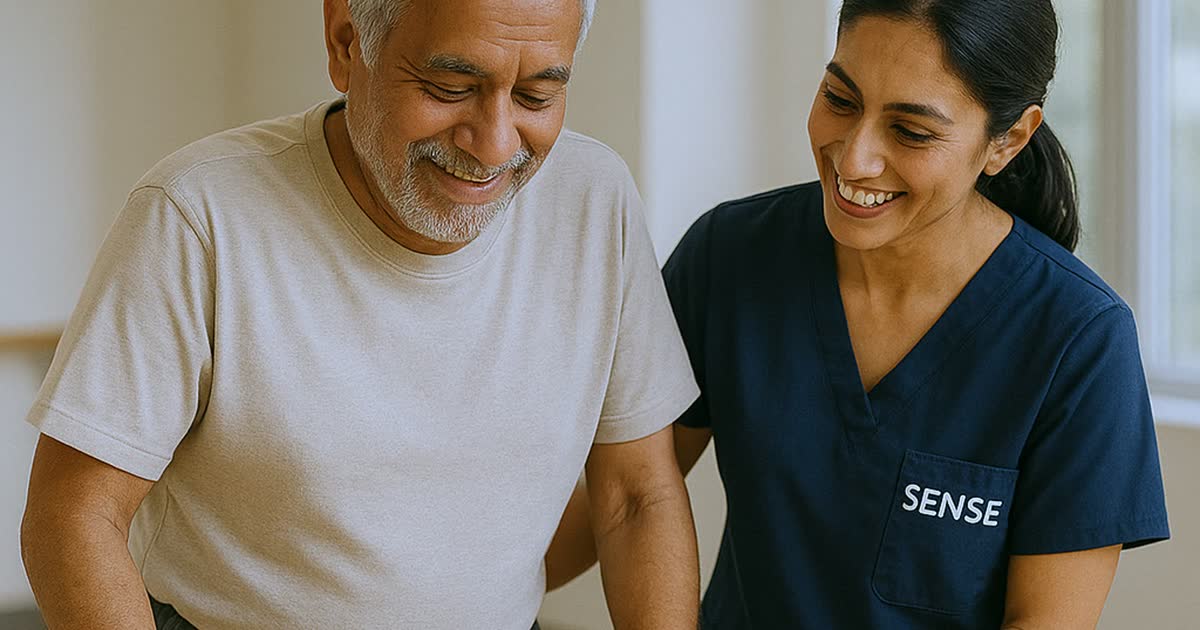
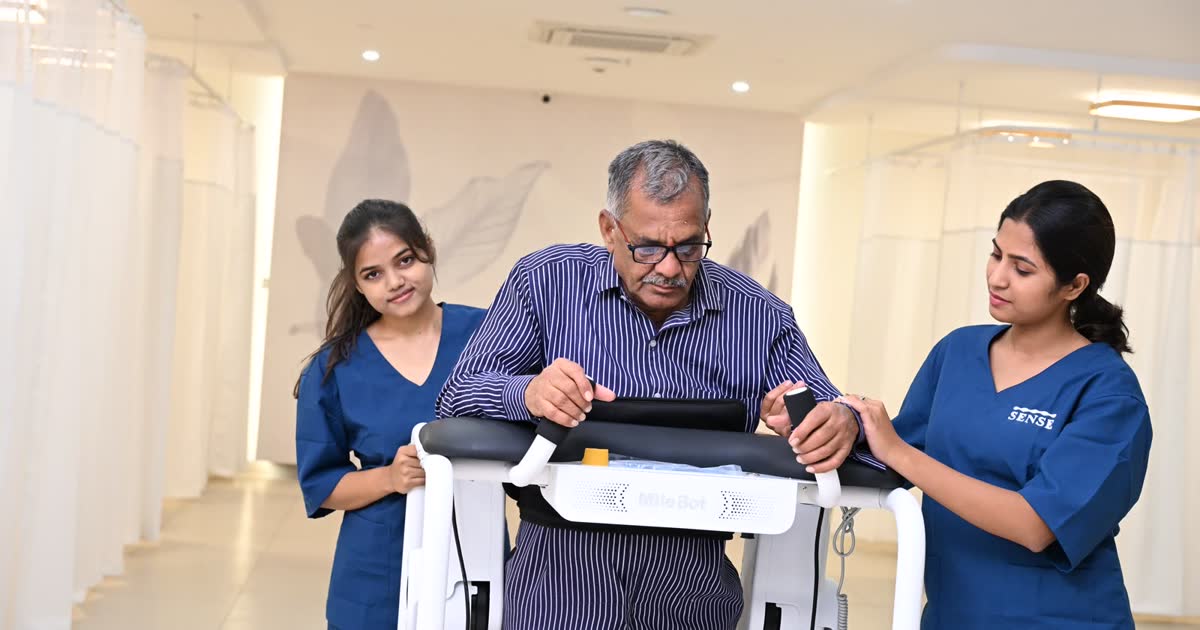
SENSE Health's senior care services include fall-prevention therapy, with balance and proprioception (body-position sense) training to build steadiness and confidence. We also provide home physiotherapy across Bengaluru for people who find travel difficult. For people with Parkinson's disease, who face a higher fall risk, see our Parkinson's rehabilitation guide. Memory problems also raise fall risk, and our dementia care guide covers safety for families.
Ask us about a home-safety review during a home physiotherapy visit, and we will tell you what is possible for your home.
Getting Help in Kalyan Nagar, Banaswadi and Nearby
A free initial consultation is a good first step after a fall, a near-miss, or when a parent "just seems unsteady". Please bring:
- Every current medicine, including sleep aids and Ayurvedic products
- The glasses, footwear and walking stick or walker they use every day
- A note of recent falls: when, where and what happened
- Any recent blood test or bone density reports
We will assess balance, strength and walking, and suggest OPD therapy, home physiotherapy or, after a serious fall or fracture, an inpatient rehabilitation assessment. Families reach us easily from Kalyan Nagar, HRBR Layout, Banaswadi, Kammanahalli, Hennur and Hebbal.
- OPD hours: Monday to Saturday, 9 AM to 7 PM
- Address: AVR Heights, 100 Feet Road, HRBR Layout 1st Block, Kalyan Nagar, Bengaluru 560043
- Call: +91 96633 34659
- WhatsApp: WhatsApp us
- Directions: Open in Google Maps
Sources
- World Health Organization. Falls: fact sheet. WHO. 2021.
- Thakkar S, Muhammad T, Srivastava S. Cross-sectional associations of physical frailty with fall, multiple falls and fall-injury among older Indian adults: Findings from LASI, 2018. PLoS One. 2022.
- India Meteorological Department. Northeast Monsoon Monograph, Chapter 3: Mean Rainfall Distribution. IMD. Accessed 2026.
- Montero-Odasso M, van der Velde N, Martin FC, et al. World guidelines for falls prevention and management for older adults: a global initiative. Age and Ageing. 2022.
- Biswal S, Kiruthika S, George SM, et al. A multidimensional analysis of fall risk among older adults in India: evidence from LASI. European Geriatric Medicine. 2026.
- Sherrington C, Fairhall NJ, Wallbank GK, et al. Exercise for preventing falls in older people living in the community. Cochrane Database of Systematic Reviews. 2019.
- Centers for Disease Control and Prevention. STEADI Assessment: Timed Up and Go. CDC. 2017.
- Centers for Disease Control and Prevention. STEADI Assessment: 30-Second Chair Stand. CDC. 2017.
- Centers for Disease Control and Prevention. STEADI Assessment: The 4-Stage Balance Test. CDC. 2017.
- NHS. Falls. NHS. Accessed 2026.
- NHS. Head injury and concussion. NHS. Accessed 2026.
- National Institute for Health and Care Excellence. Head injury: assessment and early management (NG232). NICE. 2023.
This article is for general education and does not replace advice from your own doctor. If symptoms are sudden or severe, call 108 or go to the nearest emergency department.