Good dementia care in Bangalore starts with a proper diagnosis. First a doctor rules out treatable causes of memory loss, such as thyroid problems, vitamin deficiencies, depression and medicine side effects. Then the care plan is built around the person's stage, and much of the work happens outside the pharmacy: structured mental activity, physical activity, a predictable routine, a safe home, and real support for the family member doing most of the caring.
Dementia is common in India, but it is not a normal part of ageing. The first national study, LASI-DAD (Lee et al., Alzheimer's & Dementia, 2023), estimated that 7.4% of Indians aged 60 and above have dementia. That works out to about 8.8 million people. Prevalence was higher in women than in men (9.0% vs 5.8%). Worldwide, the World Health Organization estimates that 57 million people were living with dementia in 2021, and that Alzheimer's disease may contribute to 60–70% of cases.
Is It Dementia or Just Normal Ageing?
Everyone forgets things sometimes. The Alzheimer's Association describes typical age-related changes as things like sometimes forgetting a name or appointment but remembering it later, making an occasional mistake with household bills, or now and then needing help with a new gadget setting.
Dementia is different because the problems keep coming back, get worse over time and start to affect daily life. The US National Institute on Aging (NIA) lists warning signs that include:
- Repeating the same questions
- Getting lost in a familiar neighbourhood, such as on the way back from the temple or the vegetable market
- Trouble handling money or paying bills
- Taking much longer to finish everyday tasks
- Losing interest in usual activities or people
- Difficulty finding words or following a conversation
- Personality changes, suspicion (for example, believing someone has stolen jewellery that has been misplaced), or seeing things that are not there
- New problems with balance and movement
Sudden confusion over hours or a day or two is not typical dementia. It can be delirium, often triggered by an infection or another illness, and needs a doctor the same day. Confusion with face drooping, arm weakness or slurred speech may be a stroke: call 108 or 112 immediately.
What Treatable Causes Do Doctors Check First?
This step is important. Several conditions can look like dementia and may improve with treatment. NICE guidance (NG97) advises a physical examination plus blood and urine tests to exclude reversible causes, and a check for delirium, depression, hearing or vision loss, and medicines that can cloud thinking. Specialists usually add a brain scan, unless the diagnosis is already clear.
Conditions your doctor may look for include:
- Underactive thyroid (hypothyroidism), which the NHS lists as a possible cause of memory problems
- Vitamin B12 deficiency, which the NHS notes can cause problems with memory, understanding and judgement
- Depression and anxiety, which the NHS also lists as possible causes of memory problems
- Medicine side effects, including medicines with anticholinergic effects, which NICE specifically flags. Bring every strip and bottle, including Ayurvedic, homeopathic and over-the-counter products
- Normal pressure hydrocephalus (NPH), a build-up of fluid in the brain that causes memory decline, difficulty walking and urinary incontinence. The NIA notes that NPH often improves with treatment
- Untreated sleep apnoea and heavy alcohol use, both listed by the Alzheimer's Association as causes of dementia-like symptoms
Never stop or change a medicine on your own. Take the full list to the doctor and ask whether anything could be affecting memory.
Who Diagnoses Dementia in Bengaluru?
Dementia is diagnosed by a specialist, usually a neurologist, a psychiatrist with experience in older adults (old-age or geriatric psychiatrist), or a geriatrician. Many work in memory clinics, where a team does detailed memory testing and, if needed, brain scans. In Bengaluru, these specialists work in private hospitals and in government institutions such as NIMHANS on Hosur Road, the National Institute of Mental Health and Neurosciences.
If memory and behaviour are changing quickly, over weeks or a few months, ask for an early neurology review. NICE recommends faster referral for suspected rapidly progressive dementia.
A rehabilitation team does not replace that diagnosis. Its work runs alongside it, turning the diagnosis into a day-to-day plan for therapy, nursing, nutrition and safety.
What Happens at Each Stage, and What Helps?
Dementia changes over time, but stages overlap and every person is different. The table below follows the mild, moderate and severe stages described by the Alzheimer's Association.
| Stage | What you may notice | What helps | Typical care needs |
|---|---|---|---|
| Mild | Word-finding trouble, misplacing things, forgetting recent conversations, difficulty planning or with money | Diagnosis, cognitive stimulation, regular exercise, simple routines, planning legal and financial matters while the person can take part | Mostly independent; help with bills, medicines and travel |
| Moderate | Confusion about time and place, repeated questions, needs help choosing clothes, bladder or bowel accidents, sleeping by day and restless at night, wandering, suspicion | Simplified tasks, personalised activities, toilet reminders, home safety changes, caregiver training, respite for the family | Daily help with bathing, dressing and toileting; someone nearby most of the day |
| Severe | Needs help with all personal care, difficulty walking, sitting and eventually swallowing, limited speech, more prone to infections such as pneumonia | Comfort, gentle touch and music, careful positioning, safe-swallowing advice, skin and mouth care | Round-the-clock care, often with nursing support |
The Alzheimer's Association notes that the middle stage is usually the longest and can last many years. On average, people live four to eight years after an Alzheimer's diagnosis, though some live 20 years. Planning early helps the whole family.
What Non-Drug Care Actually Helps?
There is currently no cure for any type of dementia (NIA). Your specialist may discuss medicines, but everyday care is where families can make the biggest difference.
Cognitive stimulation therapy (CST)
NICE recommends offering group cognitive stimulation therapy to people with mild to moderate dementia. CST uses a range of group activities and discussions designed to improve thinking and social functioning. NICE also suggests considering reminiscence therapy (talking through old photographs, songs and festivals) and occupational therapy or cognitive rehabilitation to support daily function.
Be wary of quick fixes. The same NICE guideline advises against offering ginseng, vitamin E supplements or herbal formulations to treat dementia, and against acupuncture. It also advises against brain-stimulation techniques, including transcranial magnetic stimulation, for treating mild to moderate Alzheimer's disease, except as part of a randomised controlled trial.
Physical activity and fall prevention
According to the World Falls Guidelines (2022), dementia and mild cognitive impairment double the risk of falls and fall-related injuries, including hip fractures. Supervised balance and strength exercise, safe walking and a hazard-free home are central to care. Our fall prevention guide for Bangalore families has a room-by-room checklist.
Routine, activity and behaviour changes
Agitation, aggression, suspicion and repeated questions, sometimes called behavioural and psychological symptoms of dementia, often have a trigger. NICE advises first checking for pain, delirium or a problem with how care is given, then using personalised activities and changes to the person's surroundings. Antipsychotic medicines should be reserved for people at risk of harm or in severe distress, and only on a doctor's advice.
Sleep
Day-night reversal exhausts families. NICE suggests a personalised plan combining sleep habits, daylight exposure, exercise and meaningful activity during the day. Ask your doctor before giving any sleeping tablet. Sedating medicines are among those that falls guidelines ask doctors to review.
Eating, drinking and swallowing
Encourage regular meals and fluids, and watch for weight loss. If the person coughs or chokes while eating or drinking, NICE suggests considering a speech and language therapist, who can advise on safe textures and positions.
Bladder problems
The Alzheimer's Association lists bladder and bowel control problems among middle-stage symptoms. Regular toilet reminders, easy-to-remove clothing and a clear path to the toilet help. Our guide to urinary incontinence treatment explains other causes worth checking.
Wandering and home safety
The Alzheimer's Association says six in 10 people living with dementia will wander at least once. Practical steps for Indian homes:
- Turn off the gas cylinder valve when the stove is not in use, or fit knob covers
- Keep medicines in a locked cupboard and use a weekly pill organiser
- Fit door latches above or below eye level, but never lock the person in alone
- Add night lights in the bedroom, passage and bathroom
- Keep a card with the family's phone number in the person's pocket or purse
Support for the caregiver
The WHO reports that informal carers give an average of five hours of care and supervision a day, and that women provide about 70% of dementia care hours. In many Bengaluru homes, that load falls on one daughter, daughter-in-law or spouse. NICE recommends that carers be offered training covering what to expect, how to respond to behaviour changes, communication skills, and how to protect their own health. Short breaks (respite) are part of good care, not a luxury.
Is Home Care Enough, or Is Assisted Living Better?
Many families feel that moving a parent out of the family home means they have failed. It does not. The right setting is the one that keeps the person safe and keeps the family well.
Home care with visiting support often works when the person is in the mild or early-moderate stage, sleeps at night, and has a carer who is coping. Extra help, or a stay in assisted living, may be the kinder choice when:
- The main carer is exhausted, unwell or has stopped sleeping
- The person wanders at night or has had repeated falls
- Swallowing problems, pressure sores or several medical conditions need skilled nursing
- Behaviour changes put the person or others at risk
- Family members work long hours or live in different cities
Many families mix options, for example home physiotherapy on weekdays with a short residential stay when the carer needs a break. Plans can change as needs change.
How SENSE Health Supports Families Living With Dementia
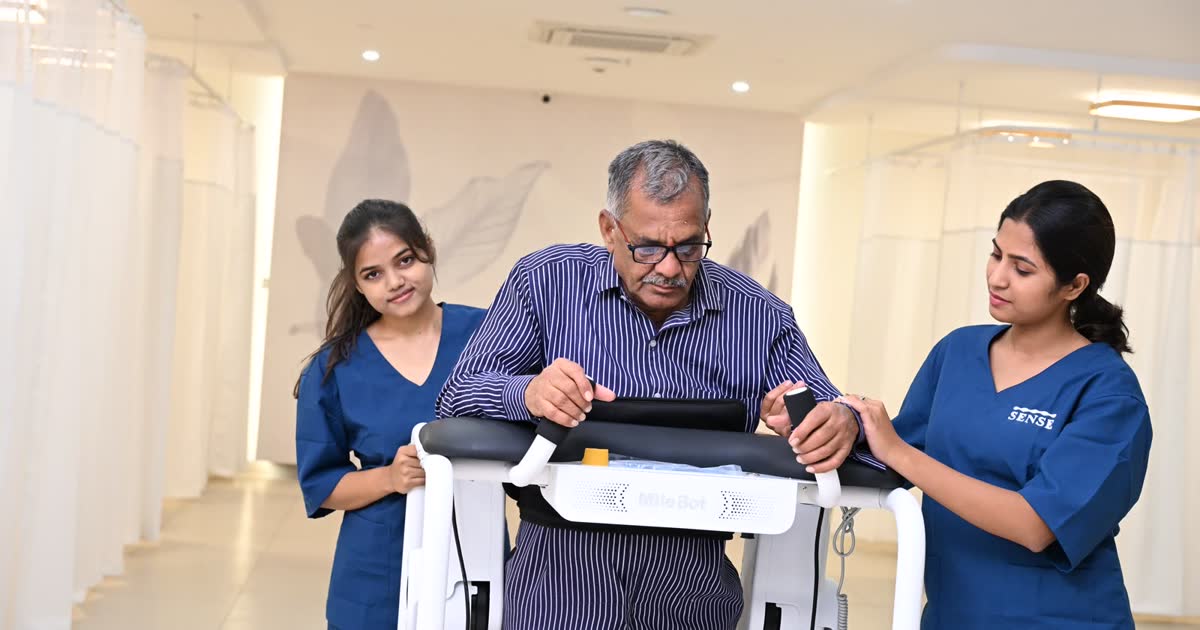
SENSE Health is a rehabilitation hospital in Kalyan Nagar, Bengaluru. Our senior care services include memory and dementia care, assisted living, home care across Bengaluru (in-home physiotherapy, nursing and rehabilitation support), fall-prevention balance therapy and clinical nutrition. Our physiotherapists, occupational therapists, speech-language therapists and swallow therapists work together on one plan, and inpatients have 24/7 nursing and 24/7 doctors.
You are welcome to ask us about group activity sessions, short respite stays, and training for family carers, and we will tell you exactly what fits your situation. Your first consultation is free.
Getting Help in Kalyan Nagar and North-East Bengaluru
If you are worried about a parent's memory, start with a free initial consultation at our OPD. Please bring:
- A list of all current medicines, including Ayurvedic and over-the-counter products
- Recent blood test reports and any CT or MRI scans
- A family member who sees the person every day, with a few written examples of what has changed and when
- Glasses and hearing aids, if used
We will listen, assess mobility, swallowing and nutrition needs, and explain whether home care, OPD therapy or an inpatient or assisted-living assessment suits your family best. We see families from Kalyan Nagar, HRBR Layout, Banaswadi, Kammanahalli, Hennur and Hebbal.
- OPD hours: Monday to Saturday, 9 AM to 7 PM
- Address: AVR Heights, 100 Feet Road, HRBR Layout 1st Block, Kalyan Nagar, Bengaluru 560043
- Call: +91 96633 34659
- WhatsApp: WhatsApp us
- Directions: Open in Google Maps
Sources
- Lee J, Meijer E, Langa KM, Ganguli M, et al. Prevalence of dementia in India: National and state estimates from a nationwide study. Alzheimer's & Dementia. 2023.
- World Health Organization. Dementia: fact sheet. WHO. 2026.
- National Institute for Health and Care Excellence. Dementia: assessment, management and support for people living with dementia and their carers (NG97). NICE. 2018.
- National Institute on Aging. What Is Dementia? Symptoms, Types, and Diagnosis. NIH. Accessed 2026.
- Alzheimer's Association. 10 Early Signs and Symptoms of Alzheimer's and Dementia. Accessed 2026.
- Alzheimer's Association. Medical Tests for Diagnosing Alzheimer's. Accessed 2026.
- Alzheimer's Association. Stages of Alzheimer's. Accessed 2026.
- NHS. Diagnosis of dementia. NHS. Accessed 2026.
- NHS. Vitamin B12 or folate deficiency anaemia: symptoms. NHS. 2023.
- Montero-Odasso M, et al. World guidelines for falls prevention and management for older adults: a global initiative. Age and Ageing. 2022.
- Alzheimer's Association. Wandering. Accessed 2026.
- Alzheimer's Association. Home Safety. Accessed 2026.
This article is for general education and does not replace advice from your own doctor. If symptoms are sudden or severe, call 108 or go to the nearest emergency department.